
Nine apps and the country's largest banks spent the first two weeks of November competing for the same refrigerators, phones and sofas. We tracked the offers, ranked the providers and worked out what the best deals were actually worth.
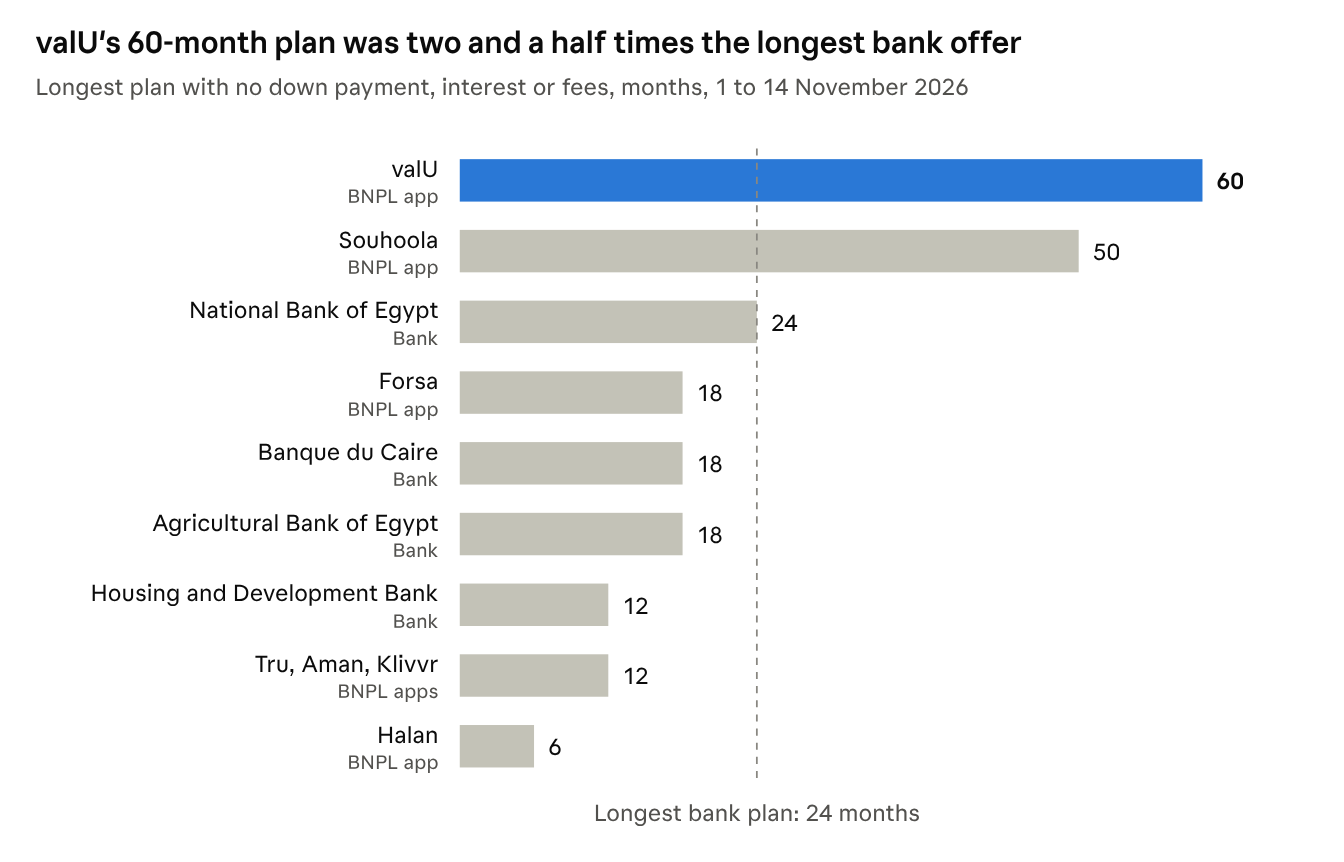
Picture a family in Cairo shopping for a new refrigerator priced at EGP 30,000 in the second week of November. Between 10 and 14 November, a comparable purchase could have been spread over 18 months at Dream Stores with Forsa, over 48 months at Raya or XPRS with valU, or over as long as 60 months at CairoCart with valU, in every case with no down payment, no interest and no fees. At 2B on 11 November, valU offered a different kind of deal: a plan of two to five years with interest, and 50% of the price back as store credit. Halan customers were offered a 50% saving on plans of 36 to 60 months at Dream 2000, and a credit card holder at the National Bank of Egypt had yet another route, 12 months interest-free at more than 40 retailers for the entire month.
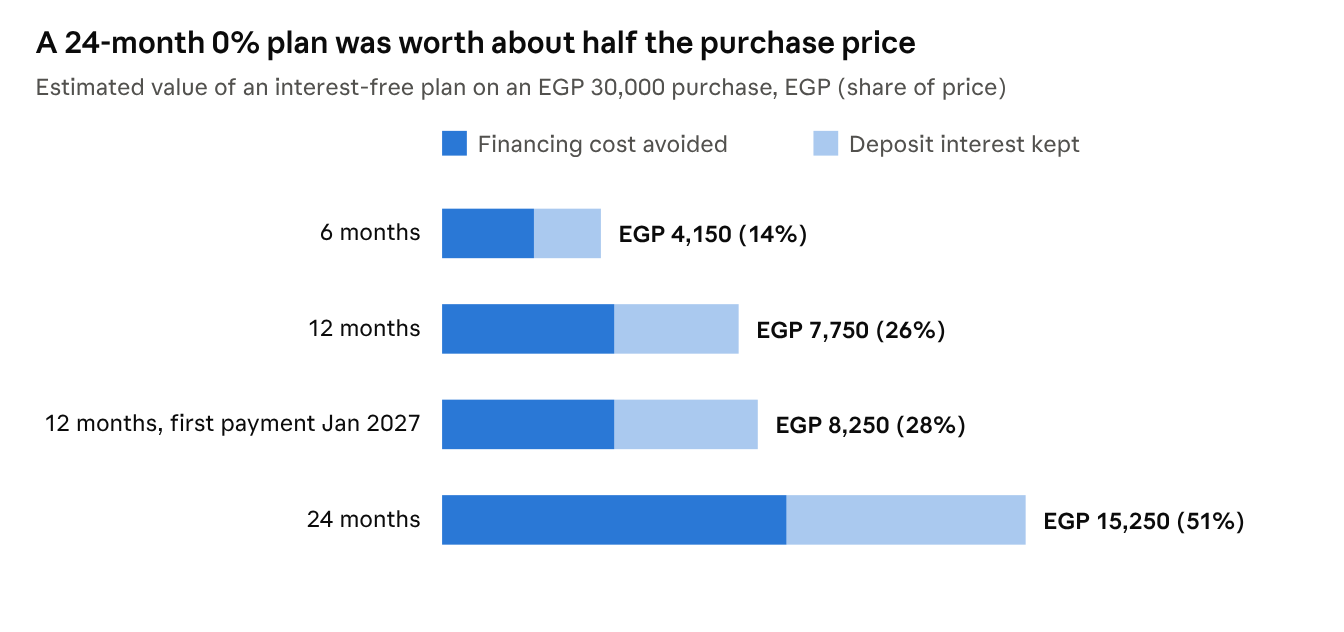
The headline on every one of these offers was some version of "0%". The value behind them was not the same. By our estimates, the gap between the strongest and the weakest structure on that EGP 30,000 refrigerator was worth more than EGP 10,000, roughly a third of the price.
Why November matters
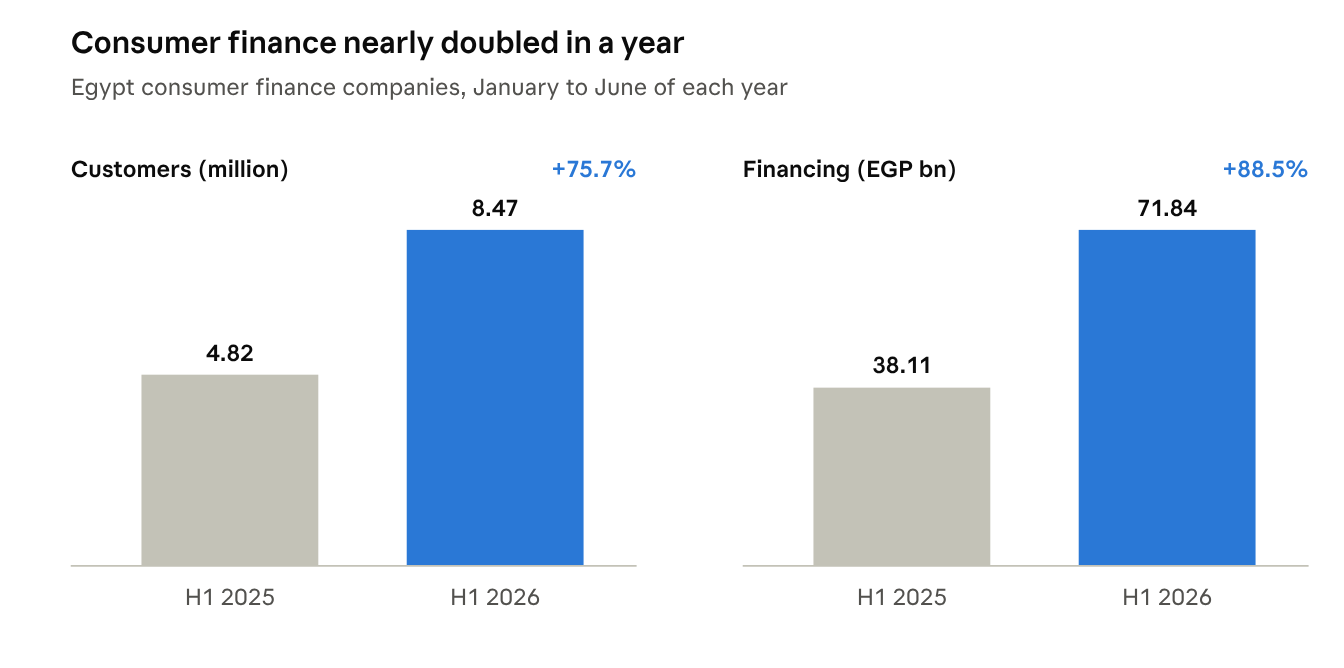
The scale of the competition reflects a market that has nearly doubled in twelve months. Customer numbers rose by about three quarters in the first half of 2026, and the value of financing grew faster still. June alone accounted for EGP 20.87 billion, more than double the same month in 2025. Across 2025, non-bank consumer finance reached EGP 96.3 billion, with valU holding about a quarter of the market.
The rate backdrop raises the stakes further. On 29 October the Central Bank of Egypt lifted its overnight deposit rate to 20%, against annual inflation of 13.9%. When cash in a deposit earns a fifth of its value a year, every month a payment is postponed without interest carries real money, and the November offers turned that arithmetic into a sales tool.
Three ways to sell "0%"
In most cases the retailer funds an interest-free plan by paying the provider a discount fee for enabling the sale. How that subsidy reaches the buyer took three distinct forms this season:
- Triple Zero. No down payment, no interest and no administrative fees, so the buyer pays exactly the shelf price, spread over the tenor. This was the dominant format, used by valU, Souhoola, Forsa, Klivvr, Tru, Aman and most banks. valU brands it as "0.0.0" followed by the number of months, from 0.0.0.6 at Town Team and amazon.eg to 0.0.0.48 at Raya and XPRS.
- Interest discounts. The plan still carries interest, but at up to half the standard rate, usually with the down payment and fees waived. This was Halan's main format in November: 50% off interest at Rizkalla and Dubai Phone on plans of up to 30 months, and a promotional rate of 1.5% a month at Audio Technology. Souhoola has used the same format at Oriental Weavers and Mehrez + Krema, and Forsa applied it to travel bookings.
- Cashback or discounts tied to the plan. The buyer pays interest and receives cashback or a price discount in return. valU's 50% cashback at 2B is the clearest example, alongside an extra 13% off at noon for valU plans of three months or more; Tru ran a similar 50% discount at 2B in July.
The benchmark for all three is what financing costs when no promotion applies: Souhoola publishes a rate of 1.5% a month on some 24-month appliance plans, and banks charge one-off fees equivalent to roughly 1% of the price for each month of tenor.
The longest interest-free tenor of the season, 60 months, was two and a half times the longest offered by any bank.
The offer map
Seven of the nine BNPL providers we reviewed ran promotions between 1 and 14 November, and valU alone pushed more than 20 retailer offers to its customers between 10 and 14 November. Most were tied to a single retailer and lasted one to three days, so the same product could carry very different financing terms within a single week. The table lists the offers by maximum tenor.
| Provider | Retailer | Max tenor (months) | Structure | Dates |
|---|---|---|---|---|
| valU | CairoCart | 60 | Triple Zero | 12 to 14 Nov |
| Halan | Dream 2000 | 36 to 60 | 50% saving | November |
| Souhoola | IncrediDeals | 50 | Triple Zero | 10 to 11 Nov |
| valU | Raya, XPRS | 48 | Triple Zero | 12 to 14 Nov |
| valU | Rizkalla | 36 in branches, 24 online | Triple Zero | November |
| Halan | Rizkalla, Dubai Phone | 30 | 50% off interest | To 30 Nov |
| valU | Dream 2000, Dubai Phone (Galaxy Z Fold8), Bosch | 24 | Triple Zero | 11 to 13 Nov |
| valU | 2B | 24 to 60 | Paid plan with 50% cashback, no cap, spendable at 2B | 11 Nov |
| Forsa | Dream Stores | 18 | Triple Zero | 11 Nov |
| Halan | Audio Technology | From 6 | Promotional rate of 1.5% a month | November |
| Forsa | Raneen | 12 | Triple Zero | 11 to 14 Nov |
| Forsa | Ehab Center | 12 | Triple Zero | 5 to 7 Nov |
| Souhoola | Xiaomi | 12 | 0% interest, first installment after two months | To 12 Nov |
| valU | B.TECH, Hanimex, Enarat | 12 | Triple Zero | 11 to 14 Nov |
| Souhoola, Forsa, Tru, Aman, Klivvr | 2B, selected products | 12 | Triple Zero, stackable with 2B discounts | 1 to 30 Nov |
| Souhoola | B.Tech (online) | 11 | Triple Zero | 11 Nov |
| valU | Winner Brands | 9 | Triple Zero | To 30 Nov |
| valU | amazon.eg, Temu (in EGP), Town Team, Shamy Stores, Dalydress, Premoda, Padel Needs | 6 | 0% interest and fees | 11 to 30 Nov |
| Halan | Carrefour, Rush Brush | 6 | Triple Zero | From 14 Nov |
| Klivvr | Participating merchants | Various | Triple Zero, no minimum, first installment 1 January 2027 | November |
Sympl and ContactNow did not publish November promotions in the sources we reviewed; Sympl is interest-free by design across three to five installments.
The banks were active for credit card holders. The National Bank of Egypt ran Triple Zero plans of up to 12 months at more than 40 retailers, including Jumia, Noon, B.TECH and Raya, extending to 24 months at some, for the whole of November. Banque du Caire offered 18 months at Dubai Phone and Miami Center in short windows, and the Housing and Development Bank moved the first installment on November purchases to January 2027.
Who won the season
We ranked the providers on three measures: the length of the interest-free tenor, how often offers appeared, and how widely they spread across retailers.
valU took first place. It posted the longest interest-free tenor of the season, 60 months at CairoCart, followed by 48 months at Raya and XPRS, and pushed more than 20 retailer offers in five days, from appliances and phones to fashion, padel gear and Temu orders paid in Egyptian pounds. It also ran the season's largest single headline, a 50% cashback with no cap at 2B, whose value depends on the interest rate and on whether the cashback is spent on a purchase already planned at 2B, as the chart further below shows.
Souhoola came second. Its 50-month plan at IncrediDeals was the second-longest full waiver of the season, and on 11 November alone it had live offers at B.Tech, Xiaomi, IncrediDeals and Miami Center, spanning electronics, furniture, automotive and medical purchases.
Forsa ranked third. Its offers were shorter, at 12 to 18 months this November and up to 24 months earlier in the autumn, but they were consistently full waivers at the large appliance and electronics chains, and buyers can repay through eight channels, including InstaPay, Fawry and Apple Pay.
Halan competed on long tenors at a lower rate rather than at zero. Its November offers combined 50% interest discounts on plans of up to 30 months at Rizkalla and Dubai Phone, and up to 60 months at Dream 2000, with Triple Zero kept to plans of three to six months at Carrefour and Rush Brush.
Klivvr won on timing. Pushing every November installment to January 2027 gave buyers up to an extra month before the first payment, at no cost, and carried the holiday season's purchases into the new year.
For credit card holders, the National Bank of Egypt's month-long program across more than 40 retailers matched the apps' common 12-month offers and exceeded all of them on availability.
What the offers were worth
An interest-free plan creates value in two ways. The buyer avoids the financing cost of a paid plan, and the buyer keeps the cash in a deposit, earning interest, while paying it out month by month. On an EGP 30,000 purchase, the chart above shows how the two add up: roughly 14% of the price for a 6-month plan, about a quarter for 12 months and close to half for 24 months.
The financing cost avoided is measured against bank installment fees of 8% for 6 months, 12% to 13% for 12 months and 24% for 24 months, and at the upper end against a flat rate of 1.5% a month. Deposit interest assumes a rate of about 20% a year, before tax. Measured against inflation instead, 24 equal installments cost about 12% less in real terms than paying the full price today. The 48 and 60-month full waivers offered by valU at Raya, XPRS and CairoCart extend these gains further, for buyers whose income comfortably covers a payment schedule of four to five years.
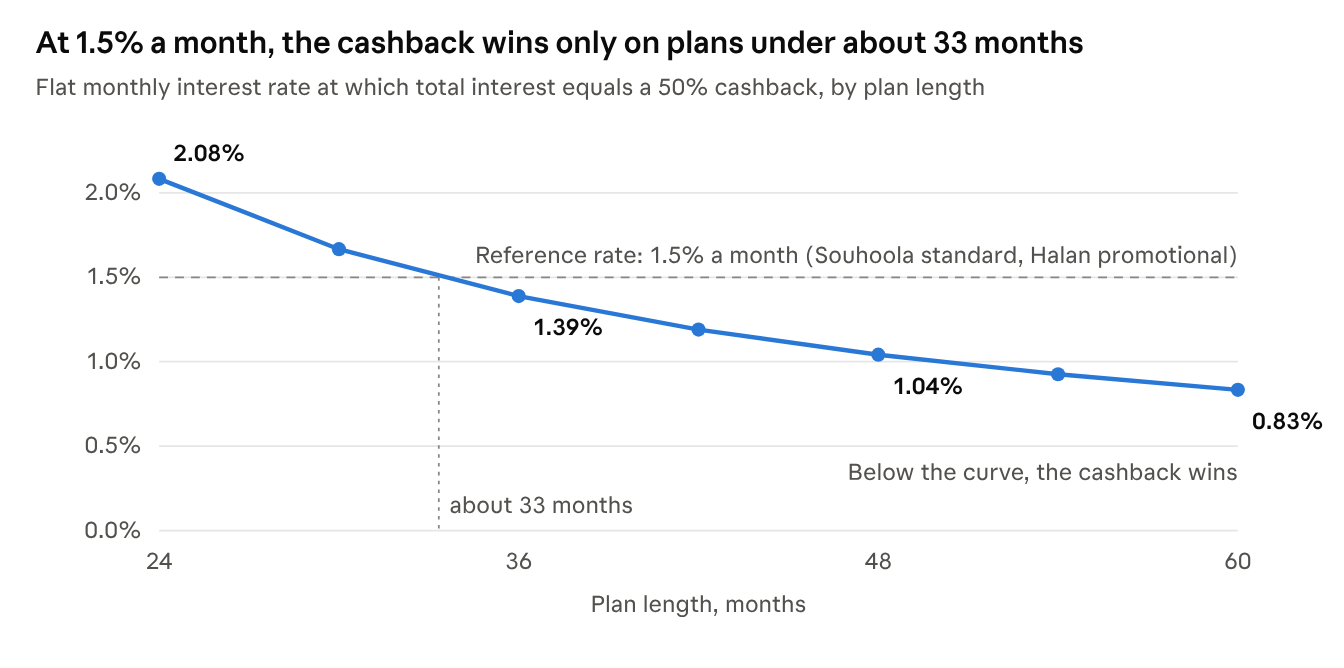
The valU offer works differently. On the same EGP 30,000 at an assumed flat rate of 1.5% a month over 24 months, the buyer would pay about EGP 10,800 in interest and receive EGP 15,000 in cashback, a net gain of about EGP 4,000. As the chart below shows, the longer the plan, the lower the interest rate at which that gain disappears.
The fine print
Beyond tenor and interest, a handful of conditions decided what buyers actually took home:
- Store-bound cashback. Cashback redeemable only at the same retailer, and only on the day of the offer, is worth its face value only for a basket that was already planned there.
- Early settlement. Some long promotional plans exclude early repayment, which matters for buyers who expect to clear the balance ahead of schedule.
- Refunds. Refunds on promotional purchases are usually processed through the provider rather than in cash.
- Minimum orders. Minimums ranged from EGP 100 to EGP 500 at the retailers reviewed.
- Timing. With most offers lasting one to three days, the date of purchase mattered almost as much as the retailer.
A clearer rulebook
The season played out under a framework that firmed up during 2026. In April the Central Bank of Egypt required that banks lend only to non-bank lenders registered with it and reporting to the Egyptian Credit Bureau (I-Score). In May the Financial Regulatory Authority published a public register of non-bank violators, and in June it linked expansion by non-bank lenders to their compliance record, with a deadline of 25 August. Together these measures point toward transparent terms and consistent credit reporting, which supports clearer comparison of offers across providers.
What the season tells retailers and providers
November showed that BNPL competition in Egypt is now fought on the design of the offer as much as on the price of the product. For retailers and providers planning the Ramadan and back-to-school seasons, four questions are worth putting to their own customers:
- How do shoppers read each structure? A Triple Zero plan can be judged in seconds, while a cashback on a paid plan asks the buyer to weigh interest against cashback over several years. Knowing which structure a given audience understands, and trusts, shapes which one converts.
- Do shoppers choose on the monthly amount or the total? Many buyers decide on the installment they can carry each month, so the most effective tenor may differ by category and income segment.
- Which apps and credit limits do your shoppers already hold? A retailer's choice of BNPL partners works best when it mirrors the credit lines its own customers carry.
- Is the offer creating demand or moving it? Measuring how much of the promotion's volume is new, rather than purchases pulled forward from other weeks, shows the real return on the discount fee the retailer funds.
For buyers, the best value of the season came from full waivers over long tenors, used for purchases they had already planned, at an installment level matched to regular income.
The Consultants MEA is a research and insights agency based in Cairo, serving clients across the Middle East, Africa and Turkey, with particular depth in consumer research across qualitative and quantitative methods.